
Quick answer: After a San Francisco car accident, the evidence that decides your claim is rarely handed to you: photos of the scene before anything moves, the other driver's and witnesses' contact details, the collision report, your medical records, and a running file of every bill and wage statement the crash touched. Some of it runs on a clock — you have 10 days to file your DMV SR-1, many surveillance systems record over themselves within days, and if a Muni bus, a city pothole, or other public property was involved, you have six months, not two years, to present a claim.
Insurance adjusters don't evaluate crashes. They evaluate files. This is how to build one that survives contact with the adjuster — organized by how fast each piece disappears.
What Counts as Evidence After a California Car Accident
Anything that shows what happened, who is responsible, and what it cost you. California Courts' self-help guide to personal injury cases lists the core: photographs of the scene and your injuries, medical records and bills, witness statements, police reports, and proof of lost income. See the list on the courts' site.
That list is accurate and a little useless on its own, because the items on it don't expire at the same rate. A photo you didn't take at the scene is gone an hour after the tow truck leaves. A witness's number is gone when they drive off. The lawsuit that uses all of it has two years on the clock. So below, the categories run in order of how fast each one disappears — not how important they are.
The First Hour: Photograph This Before You Leave the Scene
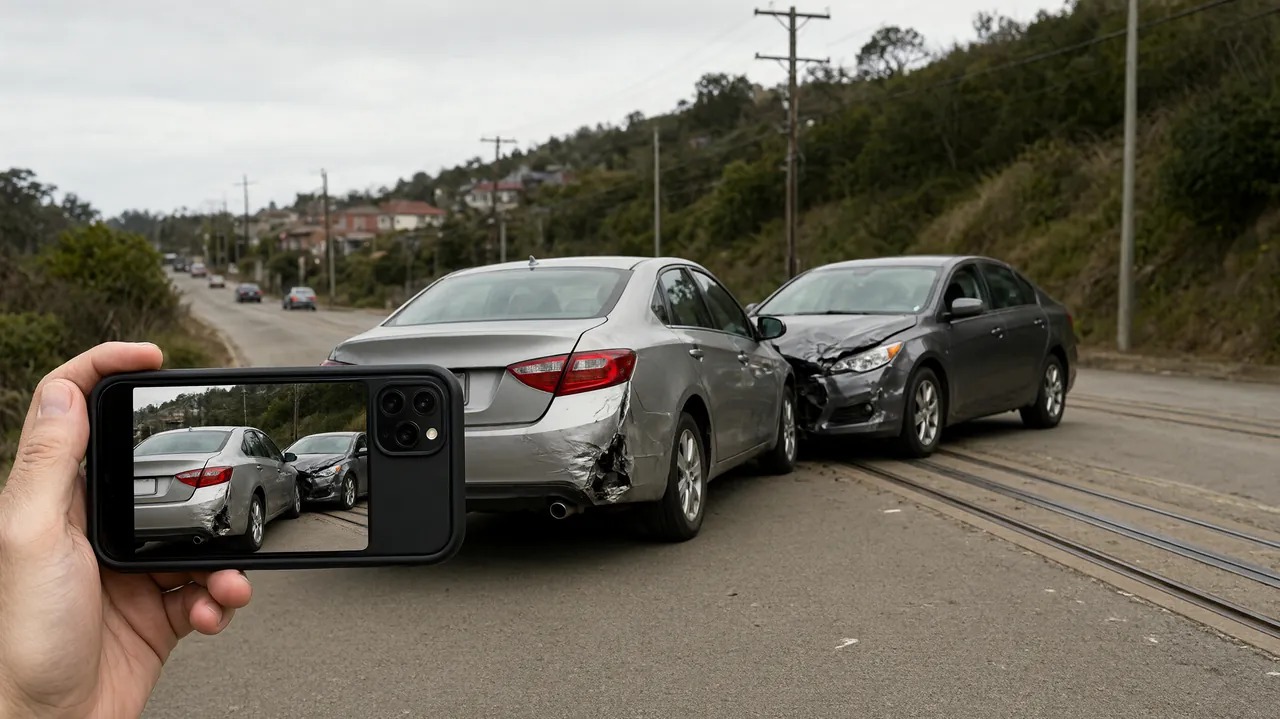
Photos are the one evidence you can never recreate, and they are the easiest to get wrong. "Accident photos" in an insurance file are usually two parked cars on a swept street — a picture of the scene, not of the accident.
Take two kinds. Close-ups of every point of contact: scratches, bumper damage, broken glass, deployed airbags, and any visible injury — those prove what broke. Then step back and shoot the whole scene from all four directions, wide enough to catch where the cars came to rest relative to the crosswalk, the signals, the lane lines, and the hill. The close-ups prove the damage; the wide frames prove position, and position is the first thing that changes, because the cars get towed and the skid marks wash off in the next rain. Keep going while it's still there: skid marks and debris before anyone sweeps them, traffic signs and signals, the road surface, weather and lighting, and the other vehicle's plate.
Take them yourself. Photographs count as evidence when the person who took them can say they accurately show the scene — that's you, with your phone, standing there. A blurry frame from a stranger's phone that you can't explain is worth less than nothing.
For everything else in that first hour — checking injuries, calling police, exchanging information — work the full sequence in our guide to what to do immediately after a car accident, then come back here. Evidence is the part that starts where that checklist ends.
The Police Report — and the 10-Day DMV Deadline
Two documents, two clocks, and most drivers only know about one of them.
The collision report. If SFPD responded, the officer's report carries the narrative, the parties, and often a fault finding that the insurance adjuster will quote back at you for the next year. It isn't ready instantly: SFPD asks you to allow at least five business days after the crash before requesting a copy, and requests go through their online portal — request a collision report from SFPD — taking about ten business days to process. Put the request in the week it opens, not the week the insurer demands answers.
The SR-1. This one is on you, at fault or not. Under California Vehicle Code section 16000, every driver must file an SR-1 with the DMV within 10 days of an accident that injures or kills anyone, or does more than $1,000 in property damage. A police report doesn't cover it, and neither does calling your own insurance company — the DMV is explicit that the SR-1 is required in addition to any report made to police, the CHP, or your insurer. Miss the deadline and your driver's license can be suspended.
The report itself isn't the verdict either. When it's thin or silent — and plenty are — photos, witness statements, and medical records are what prove fault. A report is evidence, not the decision.
Information From the People Involved
Collect it at the scene, in your notes app, while they are still standing there: the other driver's name, driver's license number, insurer and policy number, plate, and the vehicle owner's name if it differs from theirs. For witnesses — name, phone, email, and one line on what they saw. People scatter from crash scenes within minutes, and the ones who stopped to help don't come back when you realize you never got a number.
Two don'ts. Don't argue about fault at the scene: you're not qualified yet, nobody is, and "you came out of nowhere" has sunk settlements. And know that California is a comparative-fault state — even sharing blame doesn't end a claim. What the evidence shows about each driver's share is what decides it. We break down how that works in what happens if you were partially at fault for an accident.
Medical Records: Tying the Injury to the Crash
Your body is a witness that testifies politely. Adrenaline blunts whiplash, torn ligaments, and herniated discs for a day or two, so the crash feels like nothing until Tuesday. Get looked at within the first 72 hours even if you feel fine. It's evidence, not just self-care, for two reasons: the record anchors your injury to the collision date, and adjusters read a gap between the crash and your first doctor's visit as proof you weren't really hurt.
Keep everything treatment generates — ER and doctor records, imaging results, prescriptions, therapy notes, follow-up appointments, every bill — plus what the injury cost at work: pay stubs, employer statements, time-off records, and tax records if you're self-employed. That folder is where the claim gets its number. For the non-economic half, see how pain and suffering damages are actually calculated.
Footage, Dashcams, and the Windows That Close
San Francisco has more cameras than any street in California: storefronts, apartment lobbies, parking garages, Muni stops, and dashcams on half the cars that watched it happen. All of it runs on a timer — most systems record over old footage automatically, and the window can be as short as a few days.
If you or a witness can point at a camera, get the business or building name and ask that same day for the clip to be saved. A request the afternoon of the crash almost always gets a yes; the same request three weeks later usually gets a shrug. Do the same with other drivers and witnesses: ask whether they have dashcam or phone video before they forget you exist.
Video cuts both ways, and there is a whole discipline to how footage is used for and against a claim — see digital evidence in personal injury cases. And if the other driver took off, the camera sweep plus the police report is also how a hit-and-run claim actually gets paid.
Evidence of Your Losses: Bills, Wages, and Property Damage
This is the half people treat as paperwork, and it's the half that sets the number. Repair estimates and invoices, towing and storage bills, rental-car receipts, receipts for the property that got totaled along with the car — laptop, phone, child seat — medical bills, and the wage records above. Photograph your vehicle before the repairs, keep the originals of everything, and file the insurance company's written statements alongside your own. Every dollar you can't prove is a dollar the adjuster won't pay.
The Deadlines: What Disappears and When
Put all of this on one page of the same folder:
| Evidence or filing | Window | Rule |
|---|---|---|
| DMV SR-1 | 10 days after the crash | Vehicle Code section 16000 — required even if police filed a report |
| SFPD collision report request | Wait 5 business days; about 10 business days to process | Requested through SFPD's online records portal |
| Surveillance footage | Often days to a few weeks | Systems overwrite automatically — ask to save it the same day |
| Witness contact information | Hours | Ask at the scene; memory and phone numbers both fade first |
| Claim against a government entity (Muni, city pothole, public property) | 6 months | Government Code section 911.2 — not two years |
| Personal injury lawsuit | 2 years from the injury | Code of Civil Procedure section 335.1 |
| Property damage lawsuit | 3 years | Code of Civil Procedure section 338 |
That six-month row is the one that blindsides people. If a Muni bus, a city-owned pothole, an SFPD pursuit, or any public property played a part, you must present a written claim to that government entity within six months of the crash — the two-year clock never applies to it, and a claim filed in month seven is dead no matter how good it is. California Courts keeps the current deadlines on its statute of limitations page.
Mistakes That Weaken Your Evidence File
The file gets damaged more often by its own owner than by the other side:
- Deleting photos to free up your phone. Keep the originals — don't crop, filter, or overwrite them.
- Posting about the crash or your recovery. Anything public ends up in the adjuster's hands, and a smiling photo at a barbecue three weeks post-crash will be argued as proof you were never hurt.
- Giving a recorded statement to the other driver's insurer before you've talked to anyone about your rights.
- Signing a quick property-damage release that quietly settles your injury claim for nothing.
The longer list of what actually sinks claims is in common mistakes that reduce your personal injury settlement.
Frequently Asked Questions
What is the most important evidence after a car accident?
Photos of the scene before anything moves, taken by you. They show where the vehicles came to rest, the road and signal conditions, the damage, and any visible injury — and unlike a witness memory or a towed car, they cannot be recreated afterward. Medical records that tie your injuries to the crash date come second.
How do I get a copy of my San Francisco collision report?
Request it online through the San Francisco Police Department's records portal. SFPD asks you to wait at least five business days after the crash so the report can be reviewed and approved for release, and requests take about ten business days to process — so put the request in as soon as it opens, not when the insurance company demands answers.
Do I have to file an SR-1 if the police already made a report?
Yes. Under California Vehicle Code section 16000, every driver must file an SR-1 with the DMV within 10 days of an accident involving any injury or death, or more than $1,000 in property damage, regardless of who was at fault. The DMV is explicit that the SR-1 is required in addition to any report made to police, the CHP, or your insurance company.
How long do I have to file a claim after a California car accident?
Two years from the date of injury for most personal injury lawsuits, under Code of Civil Procedure section 335.1, and three years for property damage under section 338. If a government entity was involved — a Muni bus, a city pothole, public property — you must present a written claim within six months of the crash under Government Code section 911.2, and that shorter deadline is the one that catches people out.
How long does surveillance footage last after an accident?
There is no fixed rule — most systems record over old footage automatically, and the window can be as short as a few days or as long as a few weeks. If you can see a camera on a storefront, lobby, garage, or Muni stop, get the business name and ask them to save that day's clip. A request the same day almost always works; the same request a few weeks later usually does not.
Can social media be used against my claim?
Yes. Posts, photos, and comments get pulled out of context and handed to the adjuster or the defense — one smiling photo at a family event can be argued as proof your injuries were exaggerated. Say nothing about the crash or your recovery publicly, and remember that deleting content after a claim has started can create its own problem.
Talk to a San Francisco Car Accident Lawyer
The Sulfab Law Office represents people injured in San Francisco crashes — car, truck, motorcycle, pedestrian, bicycle, slip-and-fall, and wrongful death cases. In a first consultation we read the file you've built: the photos, the report, the records — and tell you honestly what it is missing and what it is worth.
If you or a family member has been injured in a San Francisco car accident, The Sulfab Law Office can review what happened and help you understand your options. Contact us for a consultation.
Disclaimer: The information on this website and blog is for general informational purposes only and is not professional advice. We make no guarantees of accuracy or completeness. We disclaim all liability for errors, omissions, or reliance on this content. Always consult a qualified professional for specific guidance.